WELCOME

Why Your Chest Feels Heavy Even When Nothing Is Medically Wrong
A calm psychology-based explanation for chest heaviness when medical tests are normal. Understand how stress, the nervous system, and muscle tension can create chest pressure without danger.
1/29/20263 min read

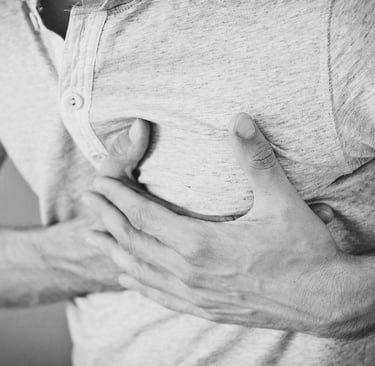
Table of Contents
Introduction
What Chest Heaviness Feels Like for Many People
When Medical Tests Are Normal but the Feeling Persists
Chest Heaviness Is Often Not a Heart Problem
The Nervous System’s Role in Chest Tightness
How Stress Changes Breathing Without You Noticing
Muscle Guarding and Chest Pressure
Why Chest Heaviness Feels Worse When You Focus on It
Common Triggers That Increase Chest Heaviness
How Chest Heaviness Slowly Settles
What Helps Without Forcing Relief
Final Thoughts
Introduction
Many people experience a heavy feeling in the chest even when doctors say everything is normal.
There is no sharp pain. No emergency symptoms.
Just a constant pressure, tightness, or weight in the chest.
This sensation can feel unsettling.
You may think, “If nothing is wrong, why does my chest still feel heavy?”
The answer is often not medical.
It is physiological and psychological, linked to how the nervous system responds to stress.
What Chest Heaviness Feels Like for Many People
Chest heaviness is usually described as -
(1) Pressure in the center of the chest
(2) A tight or restricted feeling
(3) Difficulty taking a full, satisfying breath
(4) A sense of weight rather than pain
Importantly, it often -
(1) Comes and goes
(2) Worsens during stress or quiet moments
(3) Improves when distracted or relaxed
These patterns matter.
When Medical Tests Are Normal but the Feeling Persists
Many people reach this stage after -
(1) Heart tests are clear
(2) Scans show nothing concerning
(3) Doctors say there is no serious issue
Yet the sensation continues.
This can be confusing, because the body still feels uncomfortable even after reassurance.
In such cases, the chest heaviness is not imaginary.
It is real, but the cause is not structural damage.
Chest Heaviness Is Often Not a Heart Problem
Chest heaviness without pain, spreading discomfort, or exertion-related symptoms is commonly non-cardiac.
Instead, it is often related to -
(1) Muscle tension
(2) Breathing pattern changes
(3) Nervous system activation
The chest area is highly sensitive to stress because -
(1) It is central to breathing
(2) It tightens quickly under alert states
(3) It responds strongly to emotional load
The Nervous System’s Role in Chest Tightness
The nervous system controls how alert or relaxed the body feels.
When the system senses stress -
(1) Breathing becomes shallow
(2) Muscles tighten
(3) The chest area stiffens
This happens even if -
(1) Life is stable
(2) There is no immediate danger
(3 )You are consciously calm
The body may still be operating in protective mode.
Chest heaviness is often a sign of this state.
How Stress Changes Breathing Without You Noticing
Under prolonged stress, breathing subtly shifts -
(1) Shorter breaths
(2) More chest breathing
(3) Less diaphragm movement
This creates -
(1) Air hunger
(2) Tightness
(3) Pressure sensations
Because this change is gradual, many people do not notice it happening.
The chest then feels heavy not because oxygen is lacking, but because breathing mechanics are altered.
Muscle Guarding and Chest Pressure
The chest, shoulders, and upper back muscles respond quickly to stress.
They tighten to protect vital organs.
This muscle guarding can -
(1) Reduce chest flexibility
(2) Create pressure sensations
(2) Make breathing feel restricted
Even when stress reduces, muscles may stay tense out of habit.
This is why chest heaviness can persist after stressful periods end.
Why Chest Heaviness Feels Worse When You Focus on It
Attention amplifies bodily sensations.
When you monitor your chest
(1) Sensitivity increases
(2) Normal sensations feel stronger
(3) The nervous system stays alert
This does not mean the symptom is imagined.
It means the body is watching itself too closely.
Reassurance helps less when the nervous system remains on guard.
Common Triggers That Increase Chest Heaviness
Chest heaviness often worsens with -
(1) Mental fatigue
(2) Emotional overload
(3) Poor sleep
(4) Long periods of sitting
(5) High self-monitoring
It may also increase -
(1) At night
(2) During quiet moments
(3) When you finally slow down
This pattern suggests a stress-related origin.
How Chest Heaviness Slowly Settles
Chest heaviness usually improves gradually, not suddenly.
Signs of improvement include -
(1) Pressure becoming less constant
(2) Easier breathing moments
(3) Longer periods without awareness of the chest
This happens as -
(1) The nervous system recalibrates
(2) Muscles soften
(3) Breathing patterns normalize
Time and consistency matter more than quick fixes.
What Helps Without Forcing Relief
Helpful approaches are gentle -
(1) Regular routines
(2) Light movement
(3) Allowing breathing to settle naturally
(4) Reducing constant body checking
Trying to “make the feeling go away” often increases tension.
The body releases tightness when it feels safe, not rushed.
Final Thoughts
Chest heaviness when nothing is medically wrong is usually not a sign of danger.
It is often a stress response, involving -
(1) The nervous system
(2) Muscle tension
(3) Breathing changes
This sensation is real, but it is not harmful.
As safety returns to the body, the chest usually softens on its own.
Calm, patience, and consistency allow that process to unfold.
“Read more helpful articles on our blog ”
IF YOU NEED ANY HELP ! PLEASE CONTACT US.
Frequently Asked Questions (FAQs)
Why does my chest feel heavy but tests are normal?
Stress-related muscle tension and nervous system activation are common causes.
Is chest heaviness always dangerous?
No. Many cases are non-medical and related to stress responses.
Can stress really cause chest pressure?
Yes. Stress changes breathing and muscle tone in the chest.
Why does chest heaviness feel worse at night?
The nervous system becomes more noticeable when external distractions reduce.
Should I keep checking my chest sensations?
Frequent checking often increases awareness and tension.
Contact
Reach out anytime for support or questions.
© 2025. All rights reserved.